






Don't miss a gem
Five specialist services unite under one Birmingham manufacturer
Almost eight decades of Birmingham manufacturing now support five connected services. We examine what that means for jewellers, designers and brands
Five services now sit beneath one name. The real test is what changes for jewellers.
A finished ring gives little away about the number of decisions behind it. Before it reaches the counter, somebody has considered the design, adjusted the proportions, prepared the CAD, produced the model, selected the alloy, cast the metal, set the stones, refined the surface and arranged the hallmark.
Those stages may be divided between several suppliers. Every handover introduces another conversation, another deadline and another opportunity for something to be misunderstood.
Weston Beamor believes there is a better way to organise that journey.
Following its integration with Domino Jewellery, the Birmingham manufacturer has brought five services together under the Weston Beamor name: Casting, Mounts, Wedding Rings, Bespoke and Finished Jewellery.
The headline is simple. The more interesting question is whether one connected business can remove enough complexity to make a measurable difference to the jewellers, designers and brands using it.
Weston Beamor was founded in Birmingham’s Jewellery Quarter in 1947. Originally a family-run company, it built its reputation in precious metal casting and became one of the British pioneers of lost wax casting.
That history still has practical relevance. Casting remains the foundation of the business, even as the machinery, materials and expectations surrounding it have changed.
Traditional wax carving, mould making, polishing and hand finishing now operate alongside CAD, 3D printing, scanning and laser technology. These tools have made it possible to develop complex forms with greater accuracy, repeat successful designs and move from an individual commission to a scalable collection.
Technology, however, does not decide whether a claw is too fine, a gallery is strong enough or a design will behave as intended when cast. Those judgements still depend on people who understand metal, construction and wear.
Weston Beamor became part of HM Precious Metals in 2017. The wider group employs more than 1,500 people across nine countries, giving the Birmingham business access to an international network involved in precious metals, manufacturing and technical production.
Domino Jewellery brought a different set of strengths. Its name was established in bridal jewellery, finished collections and the needs of the retail market. Bringing the two businesses together creates a broader proposition, but it also places a responsibility on Weston Beamor to preserve the specialist knowledge and customer relationships that gave each company its value.
The Domino name is transitioning into Weston Beamor, while the business says its products, people and existing relationships will remain.
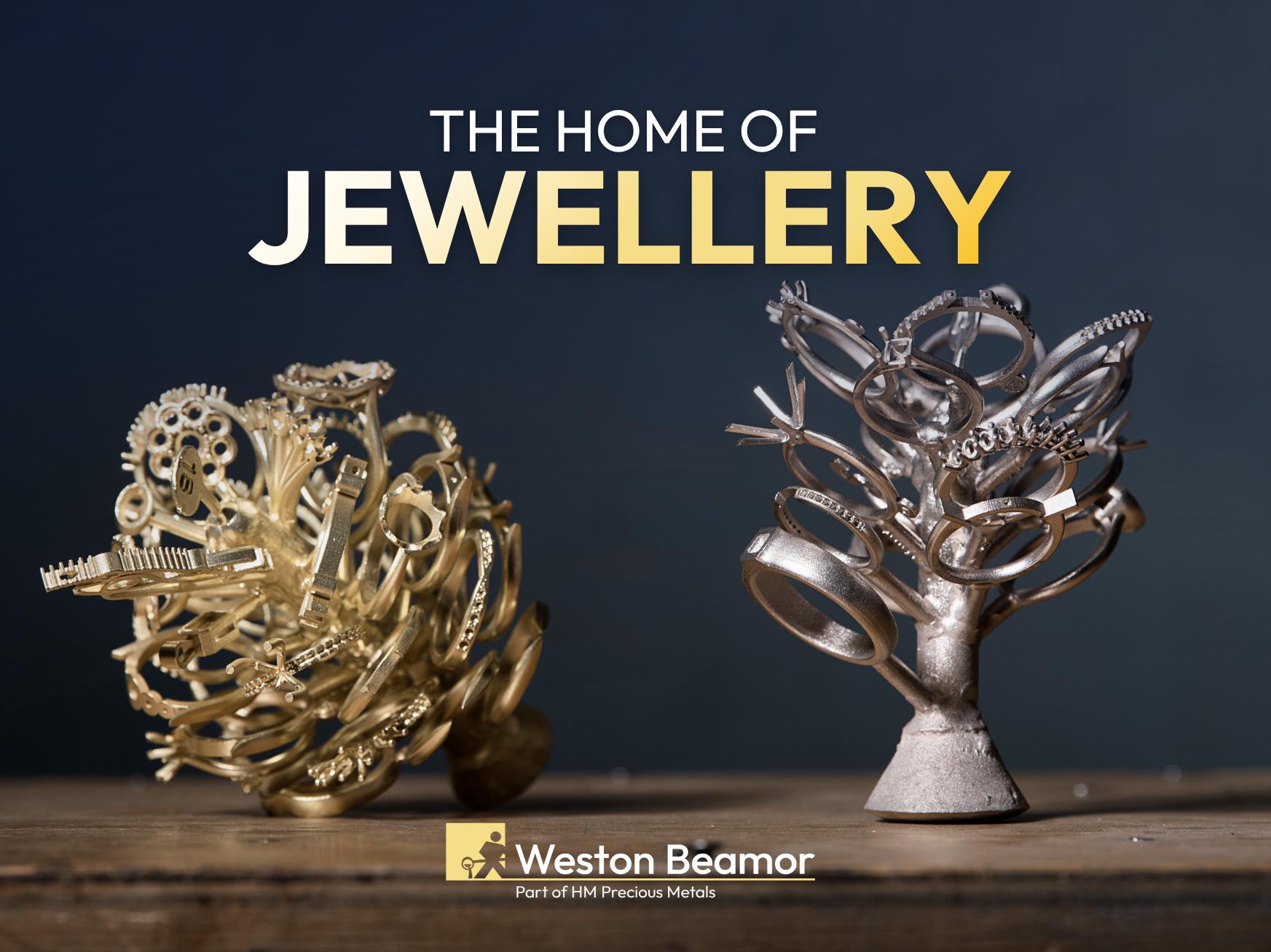
Gold and silver casting trees reflect the breadth of jewellery manufacturing brought together at Weston Beamor’s Birmingham Jewellery Quarter facility
Retailers are under pressure to offer greater choice without carrying unnecessary stock. Customers expect personalisation, but they also expect speed. Independent jewellers need suppliers capable of handling an individual commission, while larger brands require consistency across repeated production.
Using separate suppliers for design, casting, finishing and finished product can work well, but it demands time and careful coordination. If something goes wrong, responsibility can become unclear.
Weston Beamor’s answer is a more concentrated model. One business can provide several routes into jewellery production, supported by teams that already work alongside one another.
Naomi Newton-Sherlock, Creative Director at Weston Beamor, summarised the customer demand behind the integration:
"Retailers and brands increasingly want fewer, stronger supplier relationships that can offer flexibility, consistency, innovation, and joined-up thinking.”
Naomi Newton-Sherlock, Creative Director
That is the commercial argument for the new structure. Its success will depend on how clearly customers can feel those improvements in daily use.

Naomi Newton-Sherlock, Creative Director at Weston Beamor
Casting is where Weston Beamor’s manufacturing history is most visible.
The company works across mould casting, hand-carved wax and 3D printed models, giving customers several ways to arrive at the same essential point: a design ready to be translated into precious metal.
The technology may have advanced, but casting remains unforgiving. Wall thickness, shrinkage, sprue placement, surface quality and the behaviour of individual alloys all influence the result. A strong casting service therefore begins before the metal is poured. It requires the design to be assessed and prepared with the production process in mind.
For an independent jeweller, this technical support can protect time already invested in a commission. For a brand, it can determine whether a design is suitable for consistent production at scale.
Casting is also the service that connects most visibly to the rest of Weston Beamor. It supports bespoke work, mounts, bridal jewellery and the manufacture of finished collections. It is not simply one department among five. It is the production knowledge on which much of the wider proposition depends.
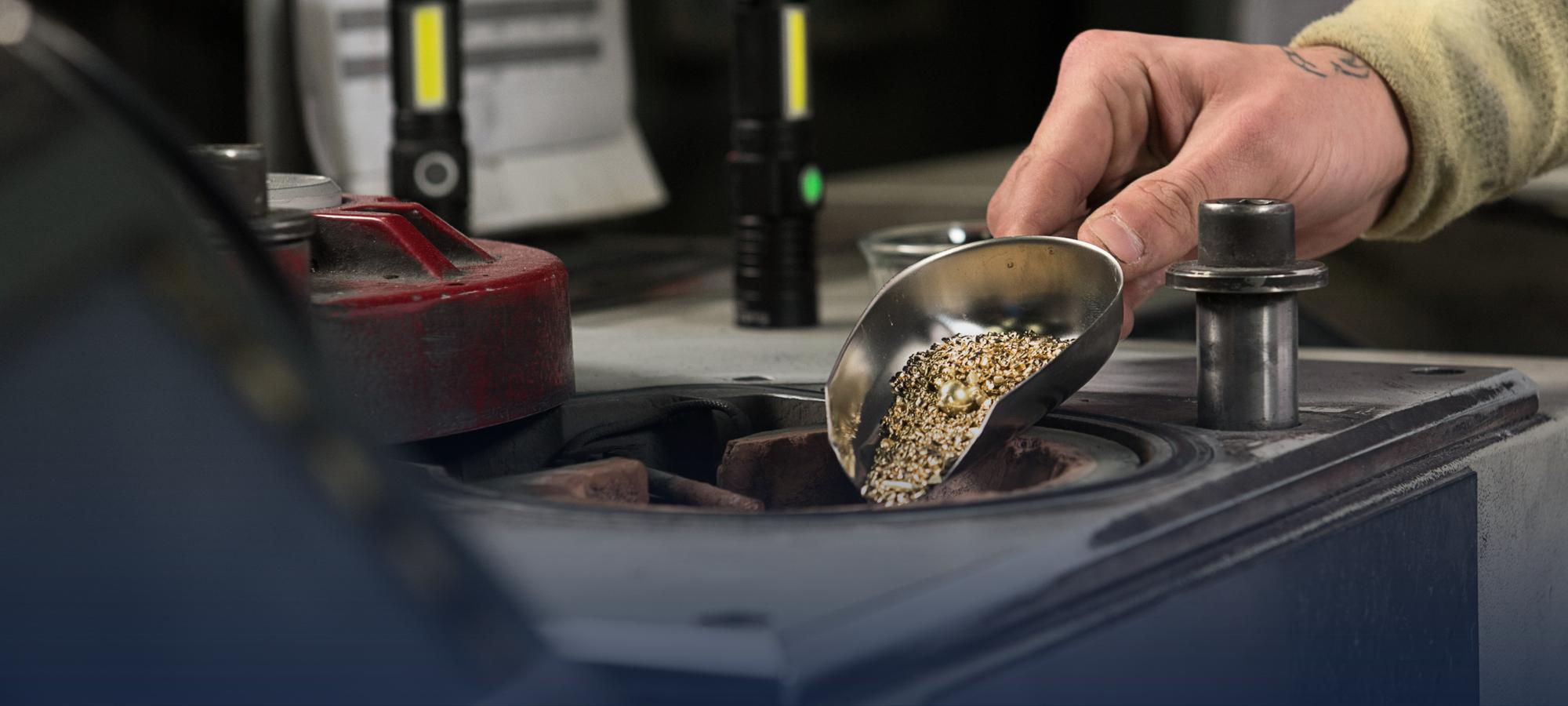
Precious metal grain is prepared for melting as part of the casting process at Weston Beamor’s Birmingham Jewellery Quarter facility. Image courtesy of Weston Beamor
A completely original design is not always the most appropriate answer to a customer request.
Weston Beamor’s mounts service gives retailers access to an established selection of engagement ring and jewellery designs, with options across precious metals, stone sizes and both natural and laboratory-grown diamonds.
The new Edits service extends that offer by allowing existing patterns to be changed. A retailer may begin with a proven design and alter its proportions, setting or other details to suit a particular customer.
This occupies a useful space between standard product and full bespoke manufacture.
For the customer, the result can still feel individual. For the retailer, beginning with an existing pattern may reduce development time, control cost and remove some of the uncertainty involved in starting from a blank page.
The value of the service will lie in the quality of the edit. Personalisation must feel considered rather than cosmetic, with every change assessed for its effect on strength, balance and setting.
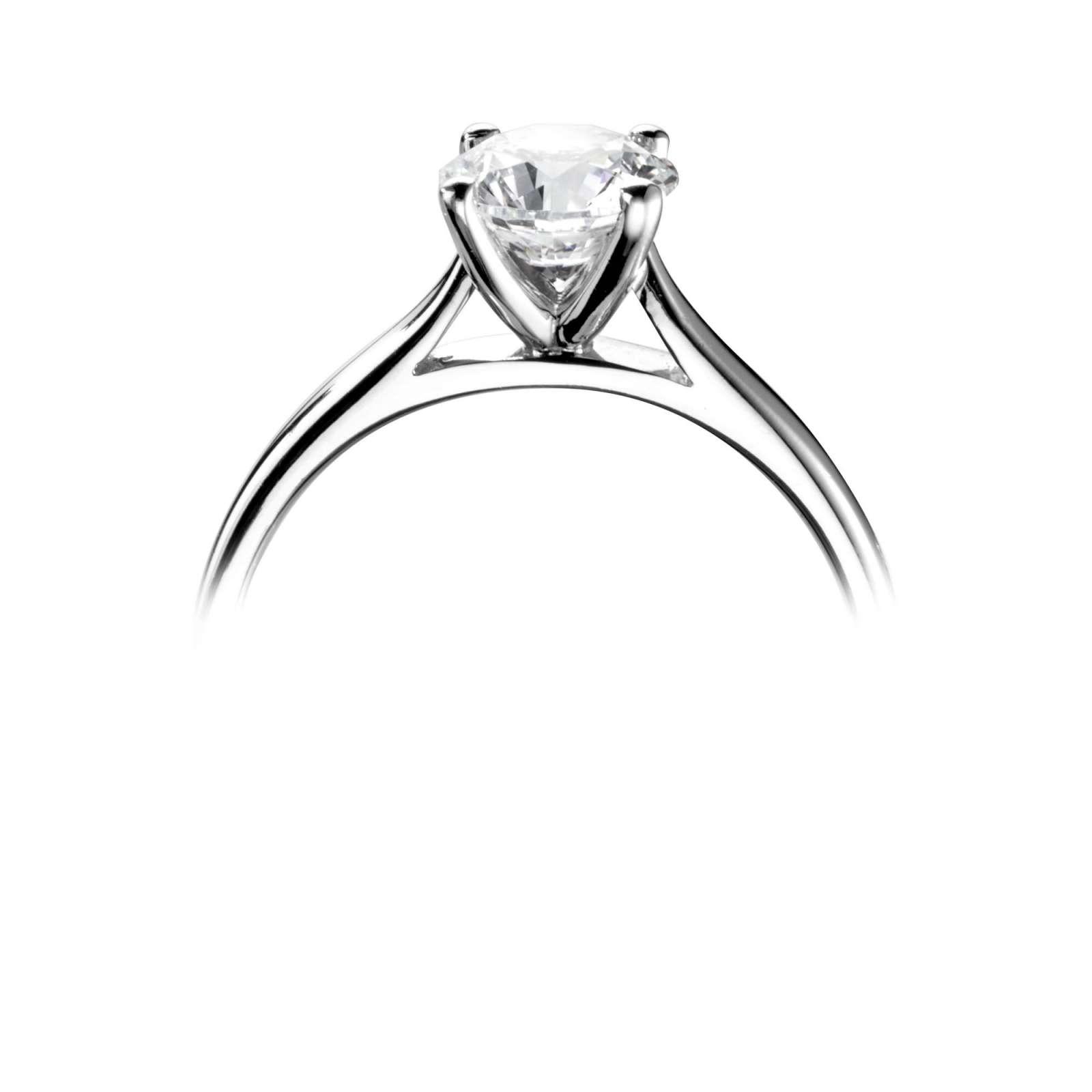
A white gold four-claw solitaire mount demonstrates Weston Beamor’s focus on stone presentation, proportion and secure construction. Image courtesy of Weston Beamor
Wedding rings appear simple until they need to sit beside an engagement ring.
A straight band may leave an unwanted gap. A shaped design must follow the engagement ring closely without appearing awkward when worn alone. Width, depth, profile and setting all affect comfort and appearance.
By bringing wedding rings and mounts into the same business, Weston Beamor has an opportunity to treat the bridal set as one conversation.
Its wedding ring service includes traditional profiles alongside contemporary, shaped and diamond-set designs. The commercial advantage for retailers is choice, but the technical advantage may be more important. Access to manufacturing knowledge can help resolve fit and proportion before they become problems for the customer.
This is also where the integration with Domino carries particular weight. Bridal jewellery depends on confidence. Retailers need reliable product, clear options and the ability to respond when a standard solution is not quite right.
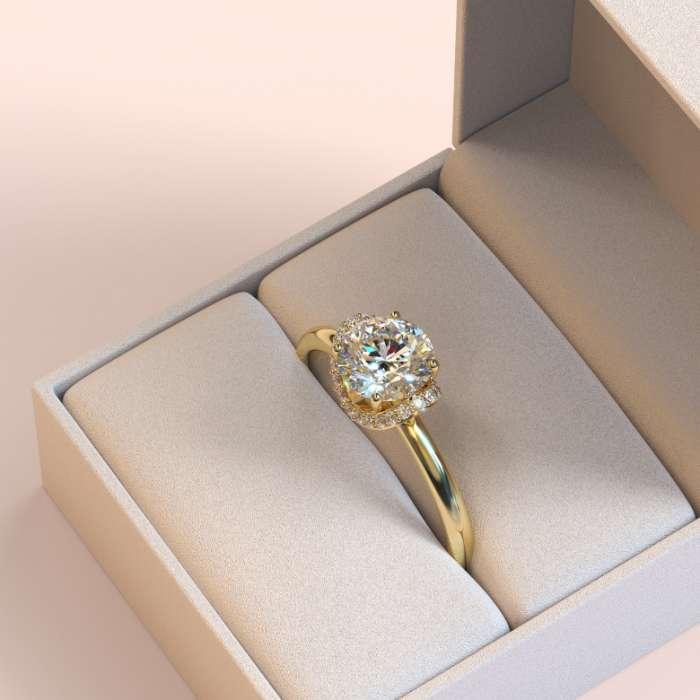
A diamond engagement ring from Weston Beamor’s bridal jewellery offering, supported by its connected mounts and wedding ring services. Image courtesy of Weston Beamor
Bespoke jewellery is the clearest expression of Weston Beamor’s connected model because it can draw on almost every capability within the business.
A commission may begin with a sketch, a conversation or an existing jewel that needs to be reinterpreted. From there, the design can move through CAD, 3D printing, casting, setting, finishing and hallmarking.
The customer sees the finished object. The retailer must manage everything required to reach it.
A successful bespoke service does more than manufacture the design it receives. It should identify weaknesses, suggest practical changes and understand when an idea needs to be challenged. A visually impressive CAD image is not enough if the finished piece is uncomfortable, fragile or unnecessarily expensive to produce.
Weston Beamor describes its role as collaborative. That is the correct ambition. Retailers do not need a production line that says yes to everything. They need access to people capable of recognising what will work.
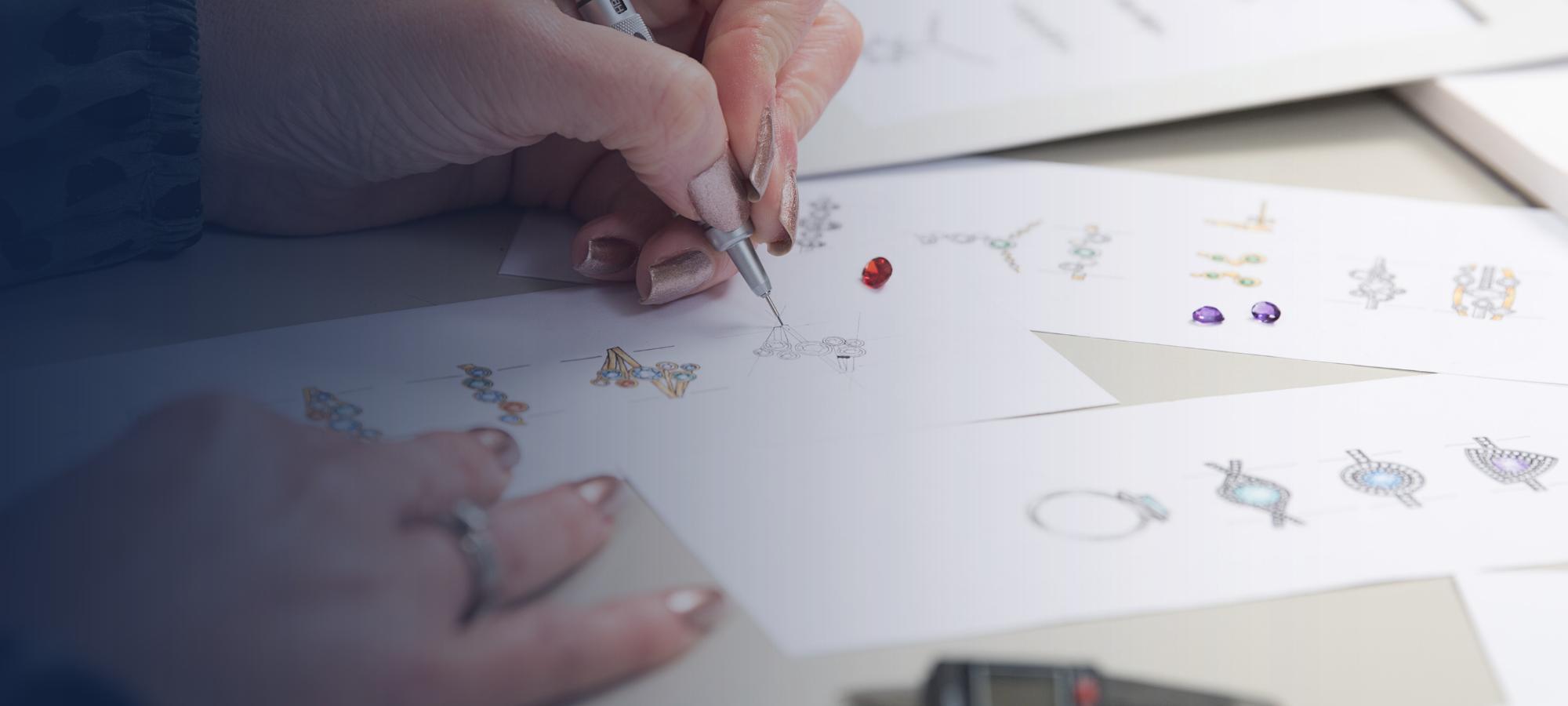
A bespoke jewellery design begins with hand-drawn concepts, bringing together creative ideas, gemstone choices and technical considerations
Finished Jewellery brings retail awareness into the manufacturing structure.
Retailers can select completed pieces and collections rather than developing every product independently. This offers a faster route to market and can help businesses build commercially balanced ranges without carrying the full cost of design and product development.
The Domino legacy is especially relevant here. Manufacturing knowledge alone does not create a successful collection. The product must also reflect how jewellery is bought, displayed, explained and reordered.
This service places Weston Beamor in two different roles. It remains a manufacturer, but it also becomes a source of product direction for retailers.
That combination could be powerful if customer feedback travels back through the business. Information from the shop floor can influence future collections, while manufacturing expertise can determine how quickly those ideas become viable products.
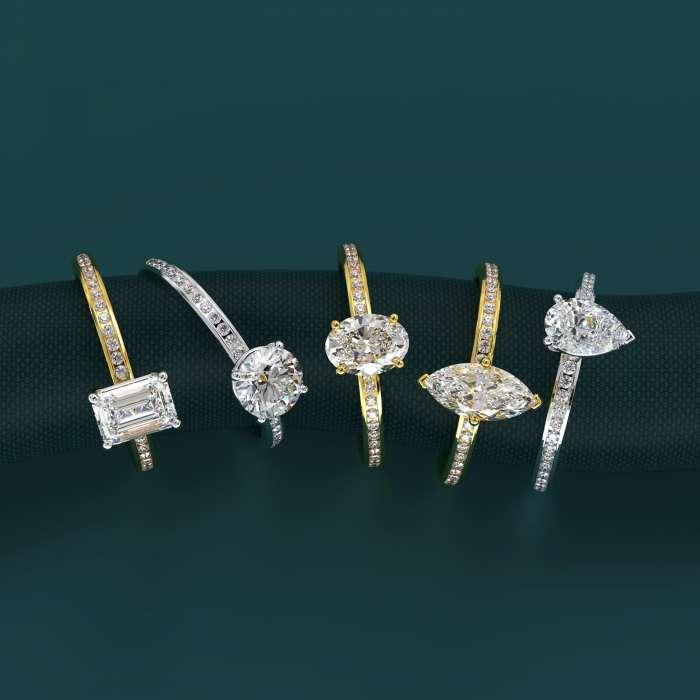
A selection of finished diamond engagement rings demonstrates Weston Beamor’s range of centre-stone shapes, precious metal options and contemporary settings
The strongest part of Weston Beamor’s proposition is not the number five. It is the connection between the services.
The company says its Birmingham operation can support design, CAD, casting, finishing and onsite hallmarking. Its online portal adds live pricing, CAD analysis and repair, mould and model libraries, multi-user access and round-the-clock ordering.
Together, those services are intended to give customers greater visibility and control.
There is a practical appeal in knowing where a piece is being made and who is responsible for it. If design and production teams communicate directly, potential issues can be identified earlier. If several stages remain within one business, fewer instructions need to be repeated and fewer parcels need to move between suppliers.
This does not mean that every jeweller will use all five services. Some may only need casting. Others may use Weston Beamor for a bespoke commission, a wedding ring or a finished collection.
The value lies in being able to enter the business at the point that suits the project, with additional expertise available when required.
Weston Beamor’s challenge is to make sure that scale does not come at the expense of access.
Customers who work with specialist manufacturers often value the person who knows their account, understands their standards and remembers how previous jobs were resolved. Integration can improve efficiency, but it can also create distance if relationships become less personal.
The company’s craftspeople, technicians, designers and customer teams will determine which version customers experience.
Its machinery can produce precision. Its systems can improve visibility. Neither can replace the reassurance of speaking to someone who understands the work and takes responsibility for solving a problem.
That human knowledge is difficult to photograph and even harder to summarise in a service list, but it may be Weston Beamor’s most important asset.

Weston Beamor’s team connects customers with the specialist knowledge behind each stage of design and manufacturing
The new Weston Beamor has a strong proposition: almost eight decades of Birmingham manufacturing, five connected services, established casting expertise, bridal and retail knowledge, digital ordering and access to a wider international group.
The integration makes sense on paper.
The next stage is to prove that customers receive more than a broader catalogue. They should experience quicker communication, clearer responsibility, dependable quality and genuine access to specialist knowledge.
The disappearance of the Domino name will also require care. Customers must be shown that the products, experience and relationships associated with Domino have not been absorbed and forgotten. They need to see where that expertise now lives within Weston Beamor.
If the business can achieve that, the five-service model offers something useful to a trade managing rising costs, cautious stock commitments and growing demand for personalisation.
Weston Beamor calls itself “The Home of Jewellery”. That is an ambitious claim. The evidence will be found in the work that leaves its Birmingham doors and in the experience of the jewellers who commissioned it.
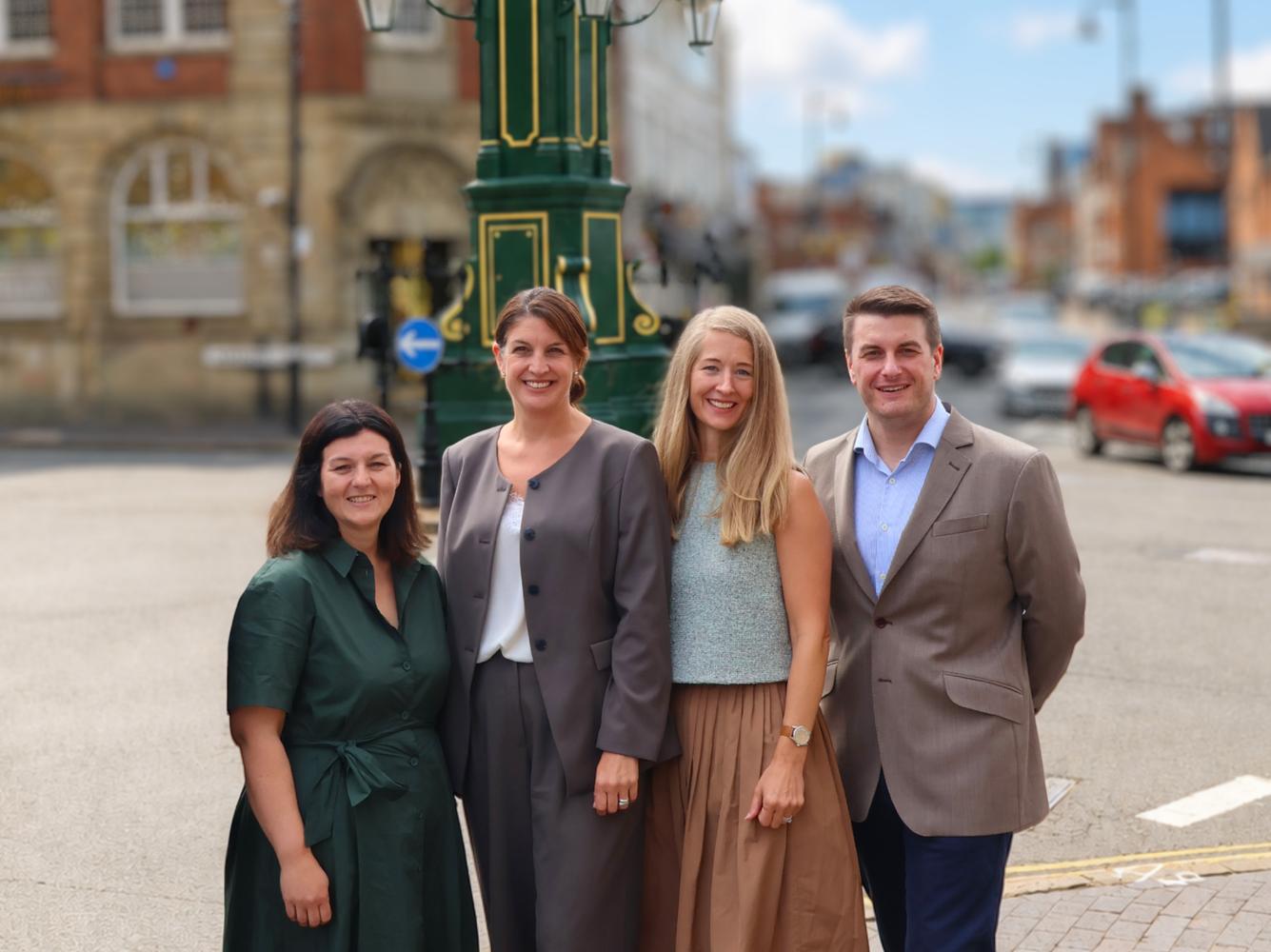
Weston Beamor team unite in the Birmingham Jewellery Quarter
The Weston Beamor and Domino integration is significant because it reflects a wider change in jewellery manufacturing.
Retailers want flexibility without unnecessary complexity. They need access to specialist skills, but they also need fewer conversations, clearer timelines and confidence that somebody is overseeing the complete job.
Weston Beamor now has the breadth to offer that. Its casting heritage gives the business technical credibility, while Domino contributes an understanding of bridal, finished jewellery and retail demand.
The five services provide a clear structure, but they should not become five isolated departments beneath one logo. The opportunity is in the movement between them.
A mount that can be edited, a wedding ring shaped around it, a bespoke alteration supported by CAD and casting, and a finished collection informed by retailer feedback all demonstrate the same idea: manufacturing works best when knowledge travels with the piece.
That is the promise of the new Weston Beamor. The next chapter will be judged by how consistently it delivers it.
Explore the Weston Beamor website and read more about the company’s history, people and manufacturing approach.
Weston Beamor’s latest Trend Edit looks at the jewellery styles influencing customer demand, from evolving bridal preferences and contemporary settings to the silhouettes, details and design references shaping the season.
The digital publication also shows another side of the company’s relationship with retailers. Alongside manufacturing and finished jewellery, Weston Beamor is providing commercial insight intended to help businesses understand what customers are noticing, requesting and buying.
For retailers planning future ranges or looking for fresh ways to discuss bridal jewellery with customers, the edit offers a useful snapshot of current design direction.
Read The Trend Edit: September 2026.
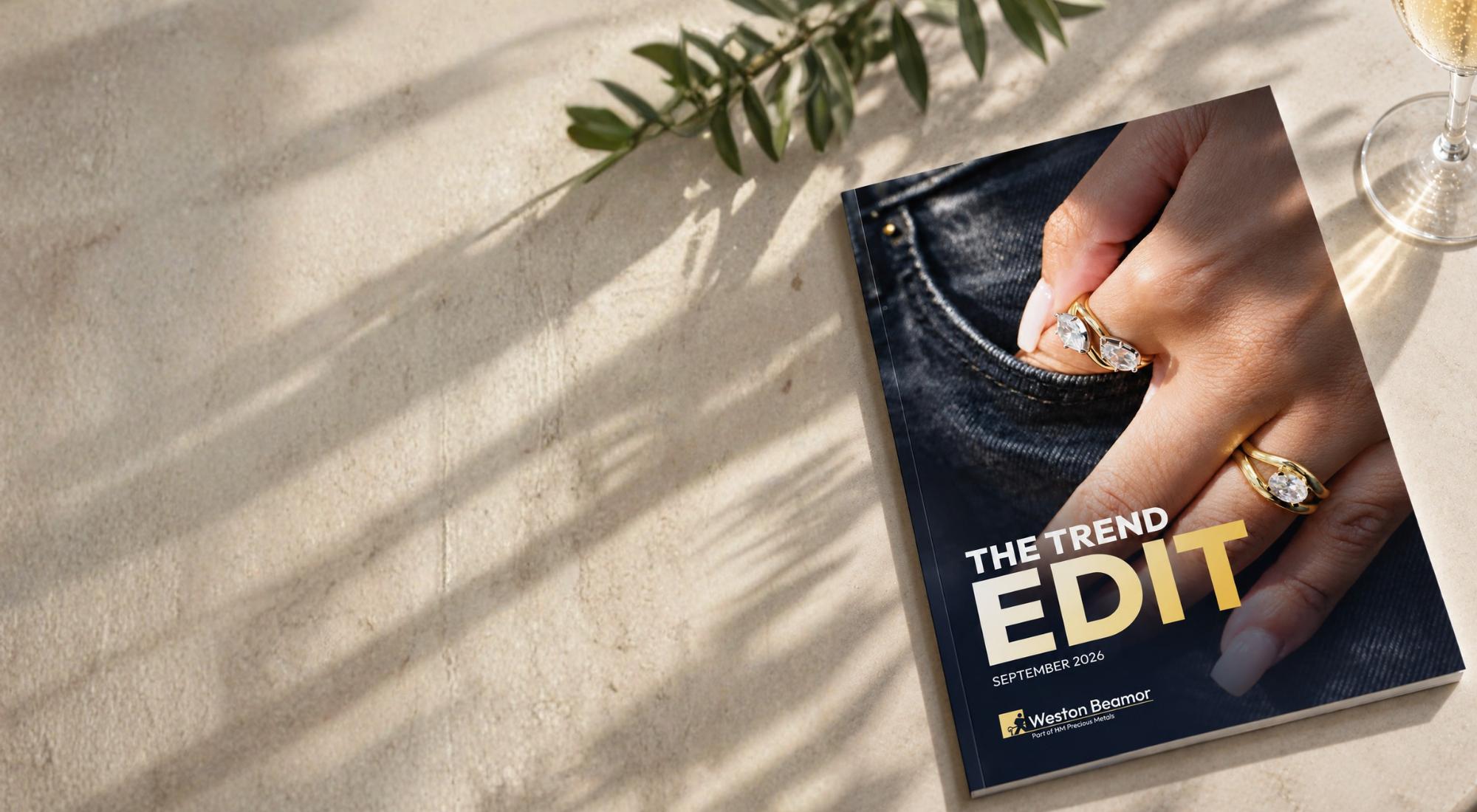
Weston Beamor’s September 2026 Trend Edit explores the bridal styles, settings and design details influencing jewellery customers this season
INSIGHTSJUL 19, 2025
UK Jewellery Sector Demands Government Action for Small Businesses
UK jewellery and allied craft leaders unite to call for urgent government reform, highlighting the structural challenges facing small and microbusinesses.
READ MORE
GJEPCJUL 27, 2025
A Pact Signed in Power — and Sealed in Gold
India–UK FTA signed by Modi and Starmer unlocks $2.5bn trade vision for Indian jewellery exports
READ MORE
INDUSTRY & POLICYAUG 8, 2025
Tariff Shock – What Trump’s 50% Duties Mean for India’s Gold, Jewellery & Diamond Trade
India’s jewellery and diamond industries face unprecedented pressure as US tariffs jump to 50%, prompting official backlash and rapid readjustments in trade strategies.
READ MORE