






Don't miss a gem
With Royal Oak Joaillerie, Audemars Piguet turns the architecture of its most famous watch into 19 standalone jewels. The real revelation is how little the icon depends on telling time
Audemars Piguet has removed the dial and movement from the Royal Oak, revealing that its greatest watch may always have been a piece of jewellery in disguise

For more than half a century, the Royal Oak has been discussed as a watchmaking revolution. Its hand-finished steel, exposed screws, octagonal bezel and integrated bracelet overturned the conventions of luxury watch design when it appeared in 1972. Yet the language used to explain its importance has often overlooked the element that made the watch so radical in the first place: the Royal Oak treated metal as jewellery.
Audemars Piguet has now made that idea explicit. Royal Oak Joaillerie is a collection of 19 necklaces, cuffs and earrings that retains the watch’s geometry, articulation and play of light while dispensing with the dial and movement altogether. It is the first time the manufacture has allowed the Royal Oak’s design to stand so completely on its own, freed from the practical responsibility of telling time.
Removing the watch from the Royal Oak sounds like a contradiction, but it exposes the strength of Gérald Genta’s original design. The Royal Oak does not rely solely on its octagonal bezel for recognition. Its identity continues through the tapering bracelet, alternating polished and satin-brushed surfaces, articulated links and the uninterrupted transition between case and wrist.
When the original reference 5402 arrived in 1972, its steel was finished with the care normally reserved for precious metal. The watch turned brushing, polishing and construction into decoration, making craftsmanship visible without relying on conventional ornament. Audemars Piguet has since produced more than 500 interpretations of the design, but its essential visual rhythm has remained remarkably intact. Audemars Piguet describes the Royal Oak as the first high-end sports watch and credits its hand-finished steel with helping to create an entirely new category.
Royal Oak Joaillerie reverses the original proposition. In 1972, Audemars Piguet elevated an industrial material through the techniques of luxury. In 2026, it takes that industrial-looking architecture and allows it to become jewellery without apology.
The result is not a watch bracelet repurposed after the removal of its case. Proportions have been expanded, links reshaped and precious stones incorporated into the construction. The familiar architecture remains visible, but it has been adjusted to move across the neck, wrist and ears rather than to support a watch movement.

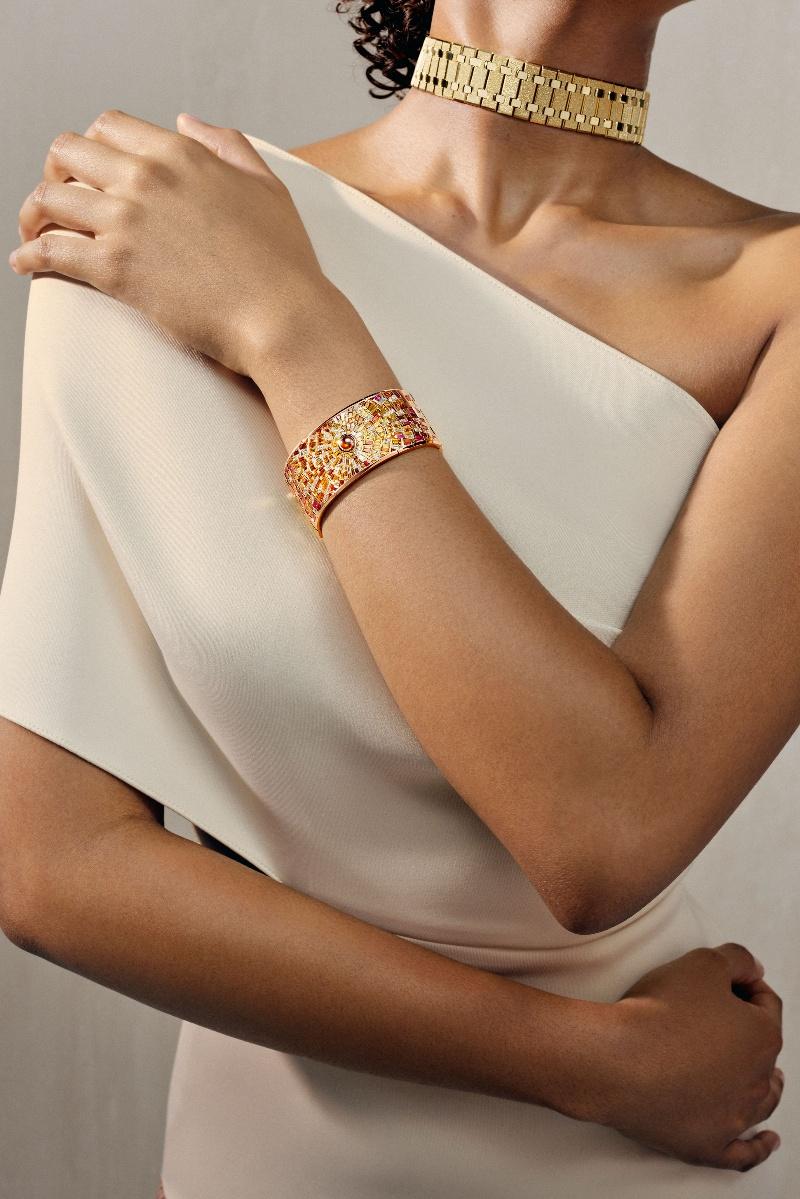
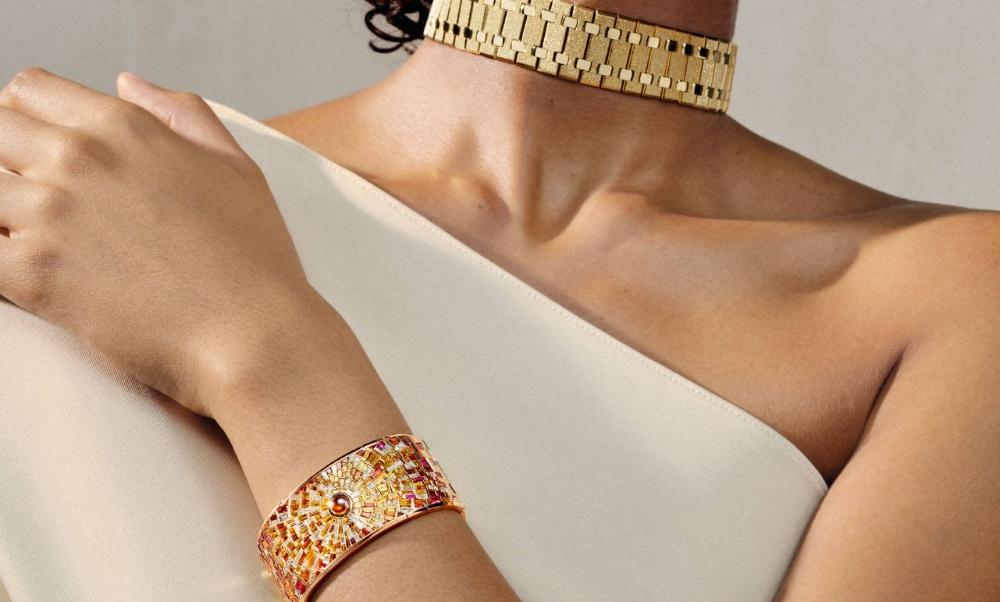
The Dream of Joux Sunburst Royal Oak cuff, set with diamonds, spessartites and coloured sapphires, worn with a Frosted Gold Royal Oak choker. | Source: Audemars Piguet
The collection is divided into three families: Frosted Gold Royal Oak, Risoud Eclipse and Dream of Joux. Each takes a different part of the Royal Oak’s character and pushes it towards a more overtly jewelled expression.
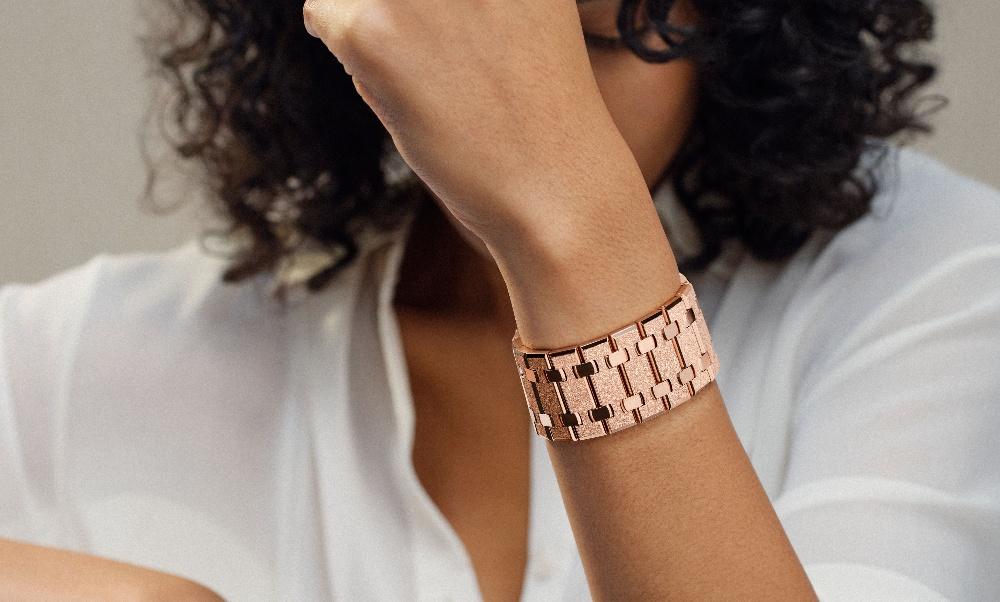
The Frosted Gold pieces remain closest to the watch. Cuffs, necklaces and chokers borrow the structure of the integrated bracelet, combining textured gold with polished studs and sharply defined chamfers. The surface treatment recalls the Frosted Gold technique introduced to the Royal Oak through Audemars Piguet’s collaboration with Florentine jewellery designer Carolina Bucci, whose approach transformed the surface of gold into something that appears to shimmer without conventional pavé setting.
This chapter is important because it does not depend on large gemstones for its impact. The architecture and finishing are the ornament, reinforcing the idea that the Royal Oak bracelet was already a sophisticated jewel before Audemars Piguet officially called it one.
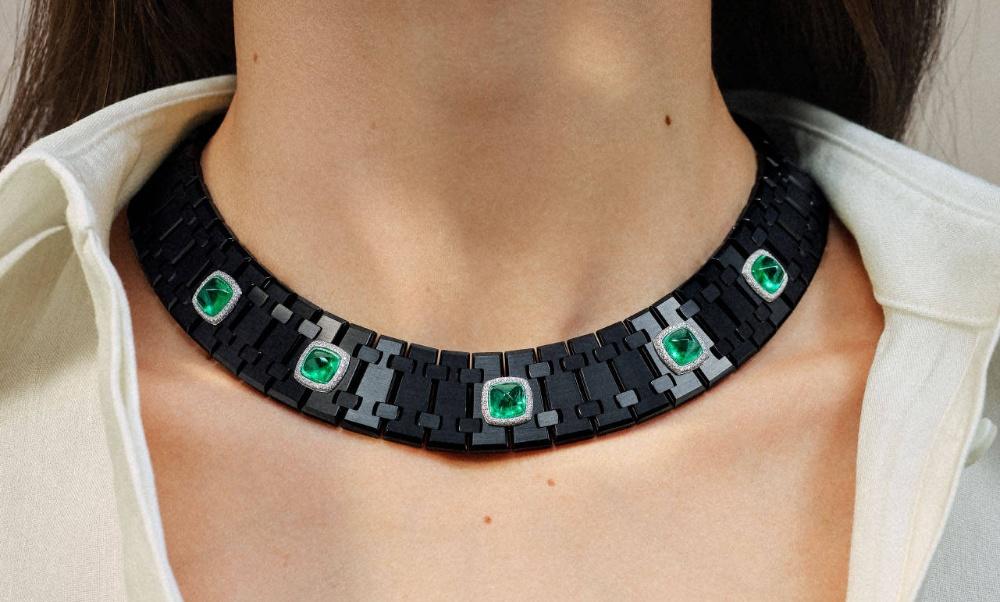
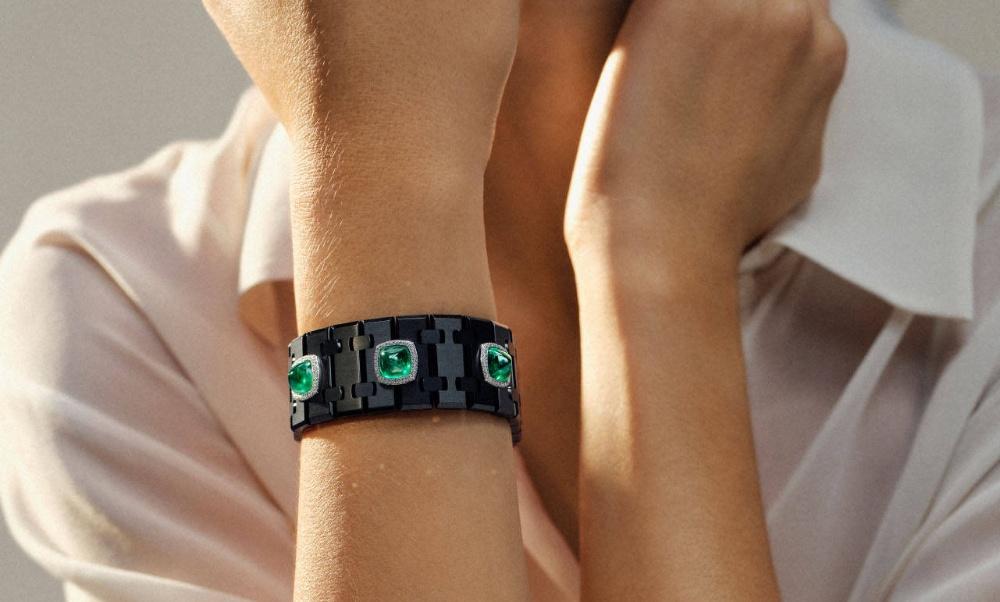
Risoud Eclipse is darker and more dramatic. A necklace and substantial cuff combine blackened titanium and white gold with sugarloaf emeralds surrounded by brilliant-cut diamonds. The colours reference the Risoud Forest near the manufacture’s home in Le Brassus, imagining green light breaking through a landscape overtaken by darkness.
Blackened titanium gives the pieces visual weight without making them physically oppressive. The emeralds appear to interrupt the repeating links rather than sit decoratively on top of them, allowing the stones to participate in the Royal Oak’s structural rhythm. The links have been individually connected to preserve the articulation expected of both a bracelet and a high jewellery cuff.
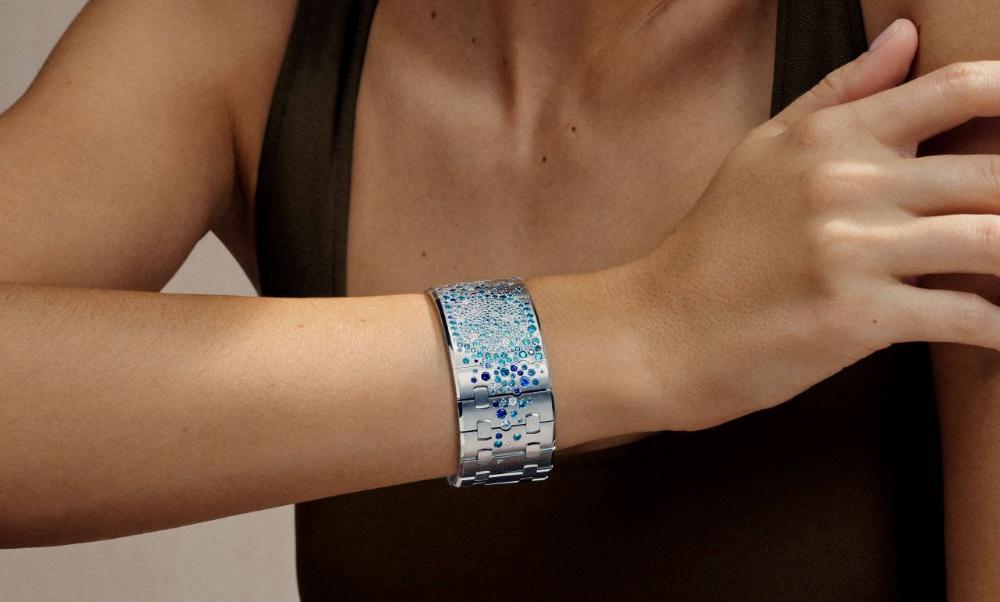
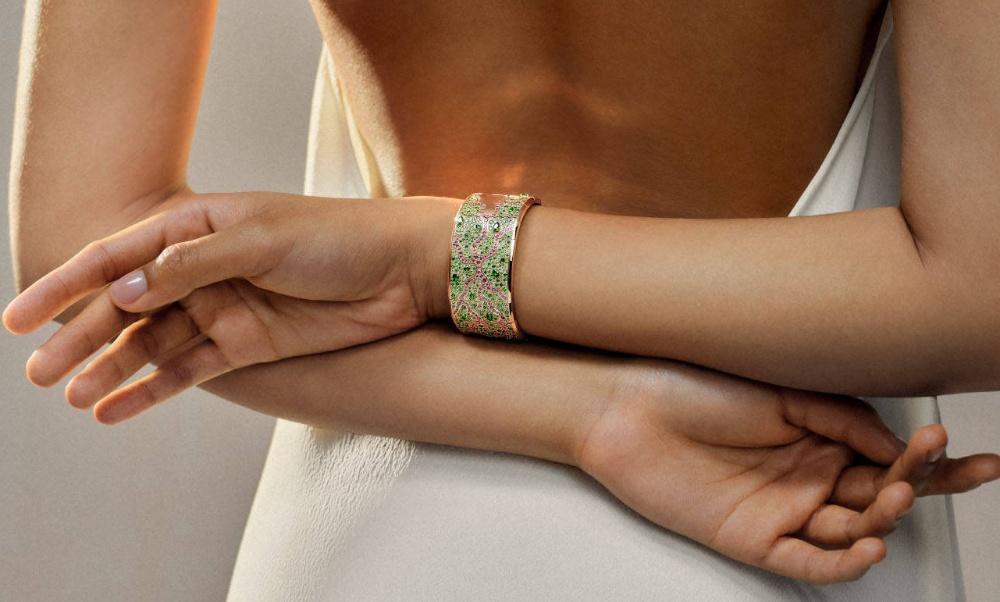
Dream of Joux is the collection’s most expansive and conventionally precious chapter. White, yellow and pink gold are joined by blue titanium, diamonds, sapphires, topazes, spessartites, tourmalines, amethysts and tsavorites. The palettes evoke frozen lakes, clear skies, alpine flowers and changing light across the Vallée de Joux, but the resulting pieces remain graphic rather than picturesque.
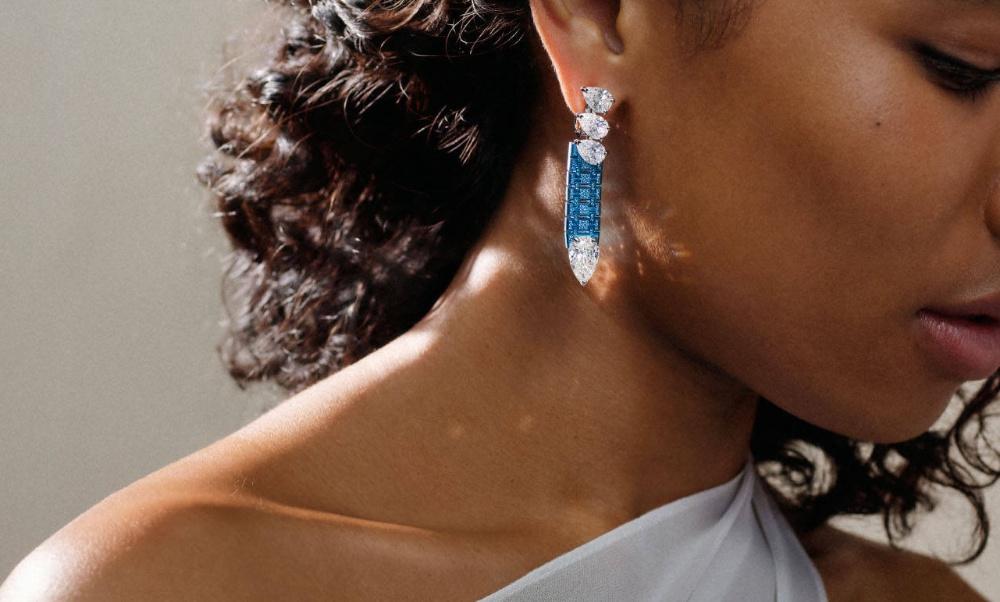
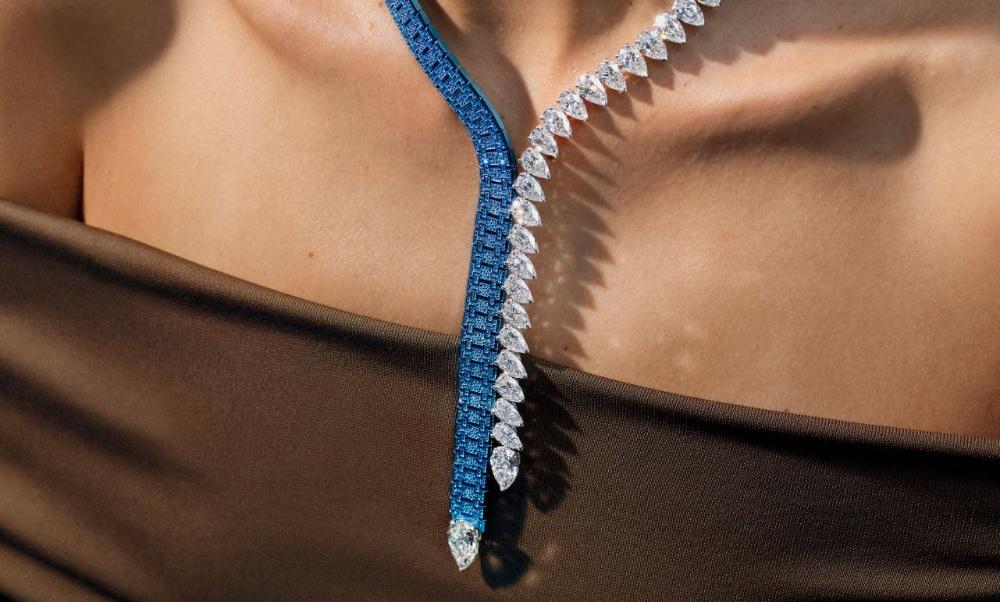
One of the most striking creations is a tie-style necklace constructed from blue anodised titanium and white gold. Pear-shaped diamonds descend beside links snow-set with sapphires in different diameters, creating an uninterrupted surface of blue light. Matching earrings extend the same composition vertically, allowing the Royal Oak’s normally horizontal bracelet language to fall and move with the body.
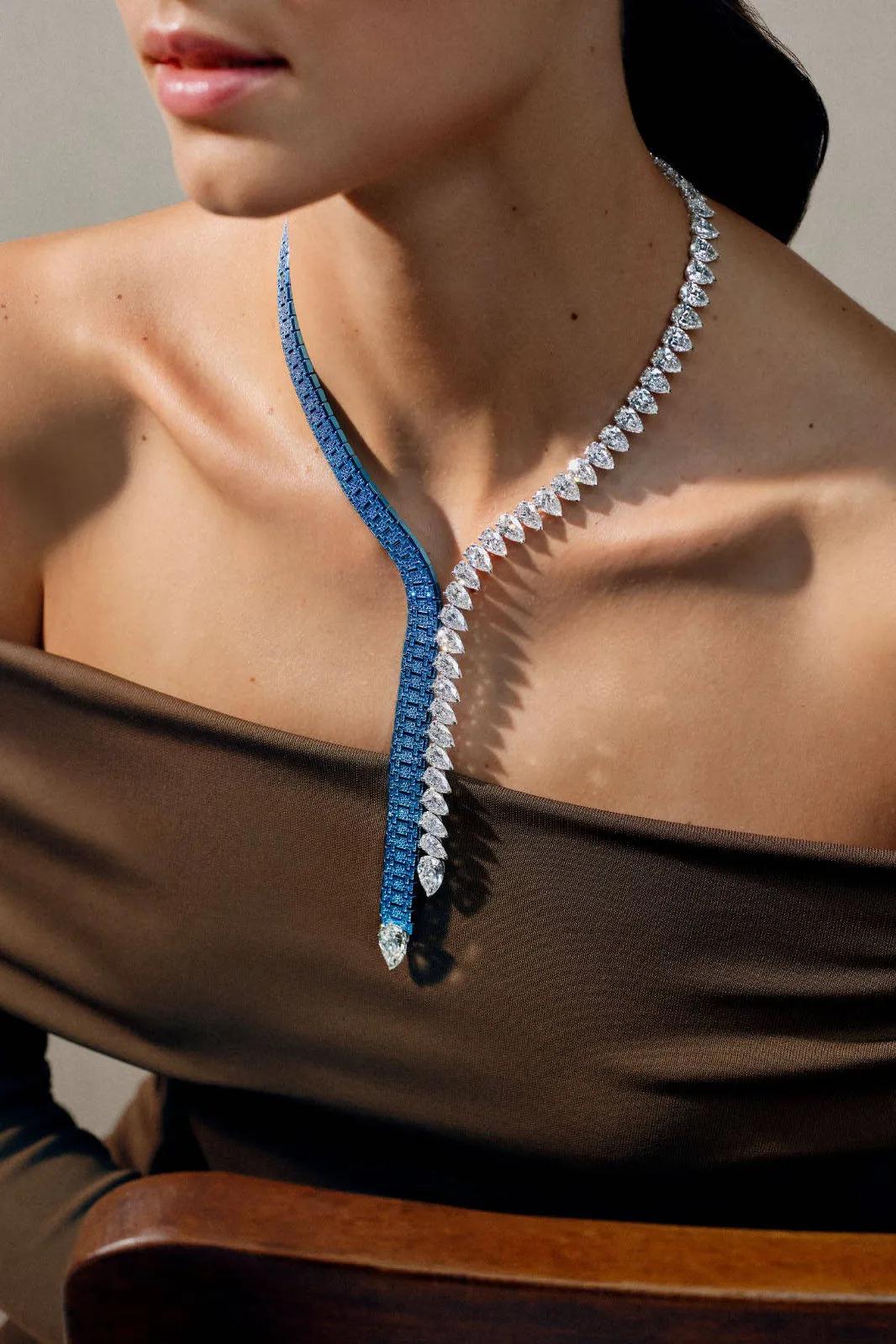
The Dream of Joux tie necklace in blue titanium and white gold, snow-set with blue sapphires and finished with a cascade of pear-shaped diamonds. | Source: Audemars Piguet
There is an obvious commercial explanation for any major luxury house entering jewellery. Jewellery has remained resilient while other luxury categories have struggled, and it offers houses another way to extend successful design codes into the lives of existing clients. Royal Oak Joaillerie, however, appears to have emerged from a more specific observation about how Audemars Piguet watches were already being worn.
“A gateway to the past and the future, the Royal Oak Joaillerie collection embodies Audemars Piguet’s free spirit. Jewellery has always played an important role in the company’s history. Drawing on our long-standing expertise, we continue to explore this creative realm alongside our core watchmaking activity to fuel our imagination, revisit our codes and enhance our approach to creation and expression.”
Ilaria Resta, Chief Executive Officer, Audemars Piguet
When the manufacture reintroduced the 23mm Royal Oak Mini in 2024, clients began stacking different versions and combining them with bracelets. Chief executive Ilaria Resta saw that wearers were treating the watches as jewellery, focusing as much on the bracelet, finishing and relationship between pieces as on the time display. Conversations with clients, including a workshop with collectors in Hong Kong, subsequently helped shape the new cuffs.
Resta has been careful to position the collection as a development of expertise rather than a new high-volume business division. Resta explained that the project is intended to strengthen skills in gemmology, lapidary work, engraving and stone setting that can ultimately feed back into the manufacture’s watches.
Production will consequently remain extremely limited. Pieces will be introduced through private presentations rather than displayed in conventional boutique windows, and much of the inaugural collection had reportedly been reserved before its public unveiling. That degree of scarcity will make Royal Oak Joaillerie difficult to judge as a commercial venture, but immediate sales do not appear to be the measure Audemars Piguet has chosen.
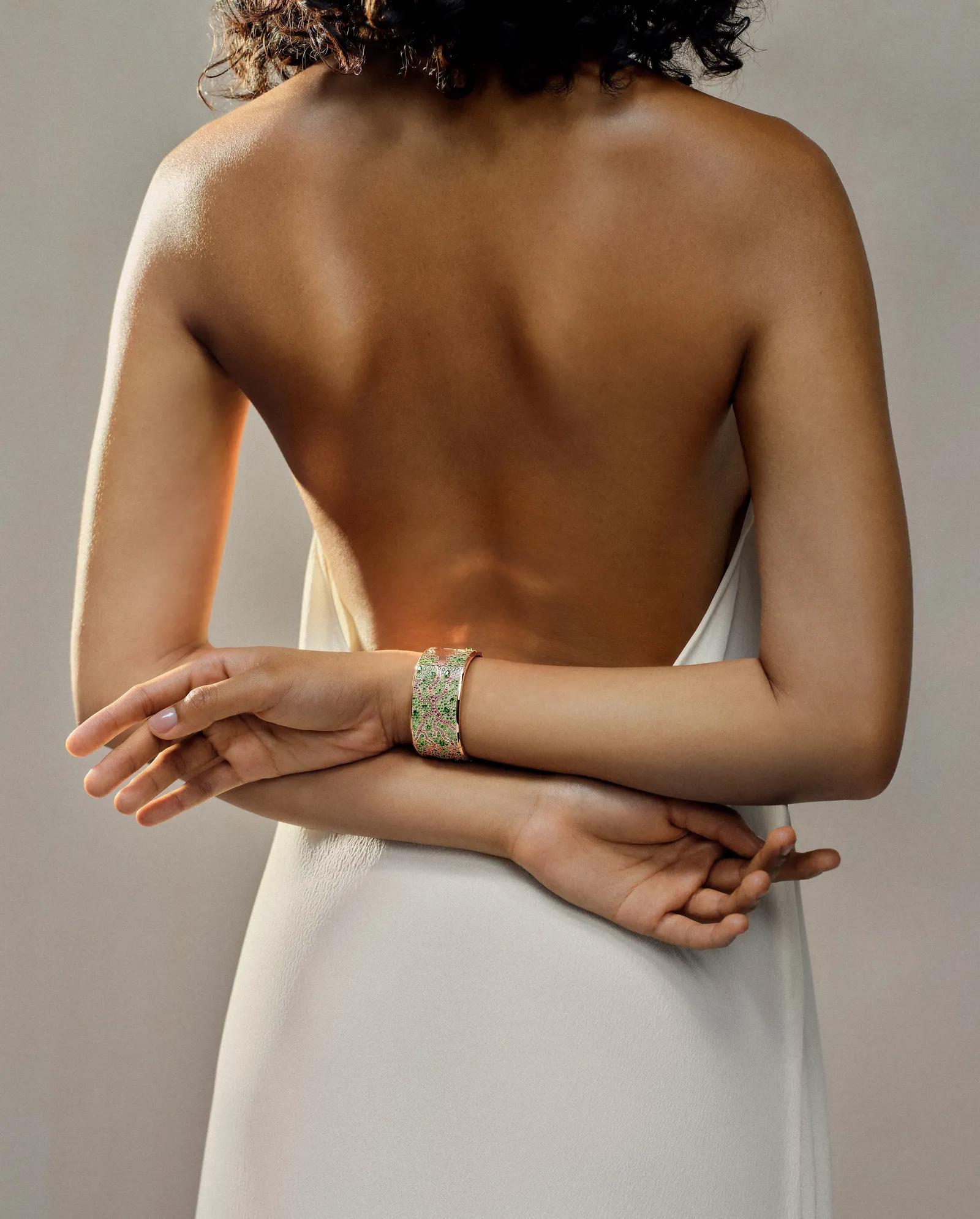
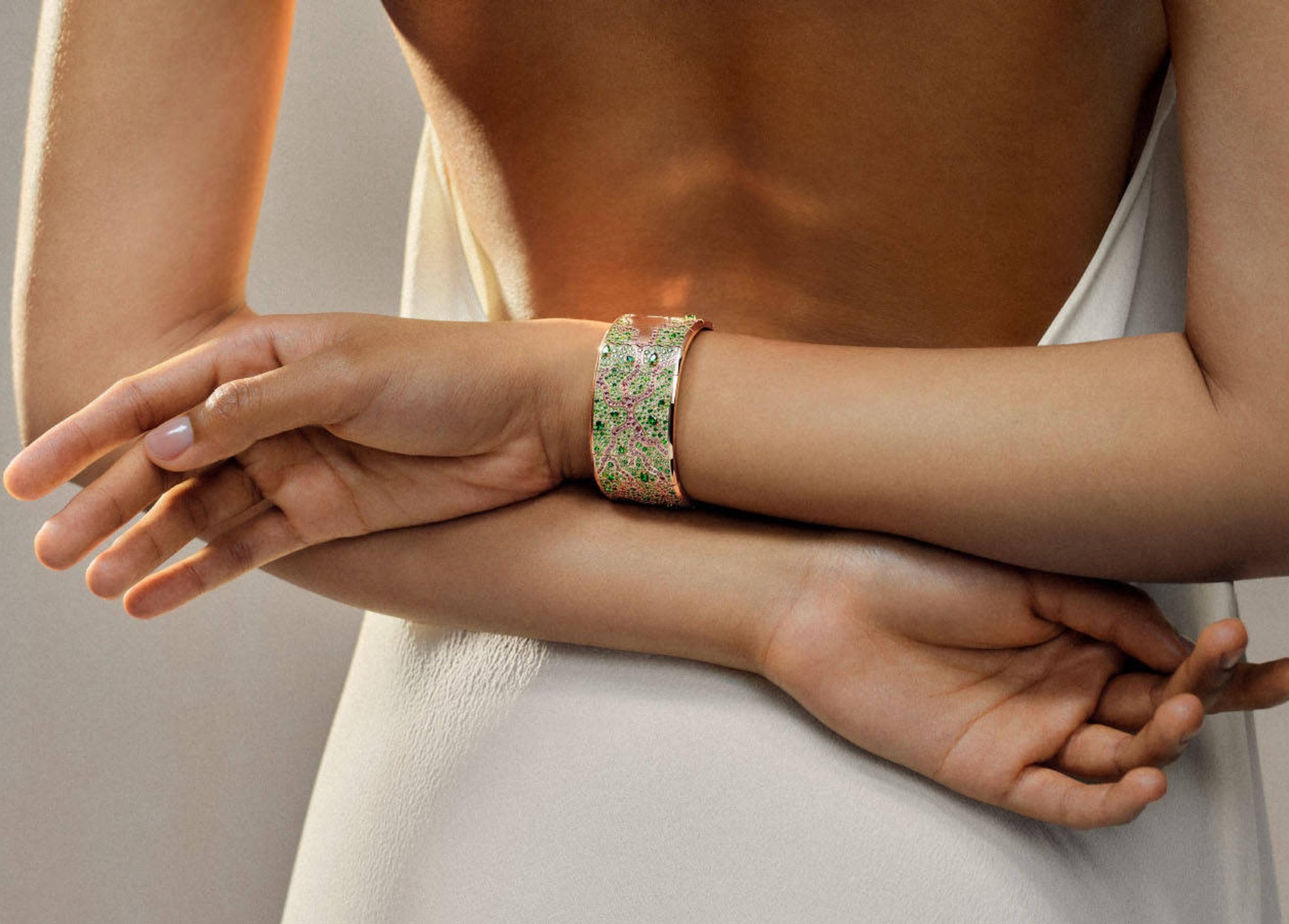
The Dream of Joux Tree of Life cuff in 18-carat pink gold, its intricate gem-setting evoking the flora and natural colours of the Vallée de Joux. | Source: Audemars Piguet
Although Royal Oak Joaillerie is being presented as a significant new direction, jewellery is not foreign territory for the manufacture. Audemars Piguet has worked with jewellers including Tiffany & Co., Cartier, Oscar Heyman and Bvlgari during its history, supplying movements for elaborate gem-set creations before developing more of those capabilities internally.
Its archive includes an octagonal diamond-set bracelet watch from 1917, created more than five decades before the Royal Oak. The manufacture opened its own jewellery workshop in the 1980s and has produced numerous gem-set Royal Oaks, jewellery watches and high jewellery experiments since then. Audemars Piguet’s official history of gem setting traces that dialogue between watchmaking and jewellery back to the company’s earliest decades.
There were already Royal Oak models formally described as “Joaillerie”. Reference 14544 appeared in 1987, while reference 14845 followed in the early 1990s with baguette diamonds around its bezel and gem-set dials. In 1998, the Royal Oak Haute Joaillerie Squelette brought together a skeletonised movement and 446 diamonds across its white-gold case, bracelet and hands.
What changes in 2026 is the absence of a watch. Previous creations used jewellery to intensify or conceal the timepiece. Royal Oak Joaillerie asks whether Audemars Piguet’s design language can retain its authority after the timekeeping mechanism disappears.

The Dream of Joux Sunburst cuff taking shape at the jeweller’s bench, with its radiating composition of diamonds, spessartites and coloured sapphires set into 18-carat yellow gold. | Source: Audemars Piguet
The collection arrives at a complicated moment in the Royal Oak’s history. Few luxury designs possess comparable recognition, and that recognition gives Audemars Piguet enormous freedom. The octagon, exposed hardware, articulated bracelet and sharply controlled finishing can be carried into new objects without losing their source.
That strength also presents a risk. Audemars Piguet has spent decades managing a business in which one family of watches commands an exceptional share of cultural attention. Translating the Royal Oak into jewellery could deepen its relevance, but it could also make the manufacture appear increasingly dependent on a single idea.
The answer will depend on whether these pieces develop lives of their own. A cuff that works only as an accessory to a Royal Oak watch remains secondary to the watch. A cuff that collectors want even when no watch is present begins to establish a genuine jewellery language.
The strongest pieces in the collection seem designed with that challenge in mind. Risoud Eclipse does not merely repeat a bezel or reproduce the outline of a dial. Dream of Joux introduces colour, asymmetry and vertical movement that would be difficult to accommodate within the restrictions of a wristwatch. These designs feel most persuasive when they move beyond quotation and allow the Royal Oak’s principles to generate something new.
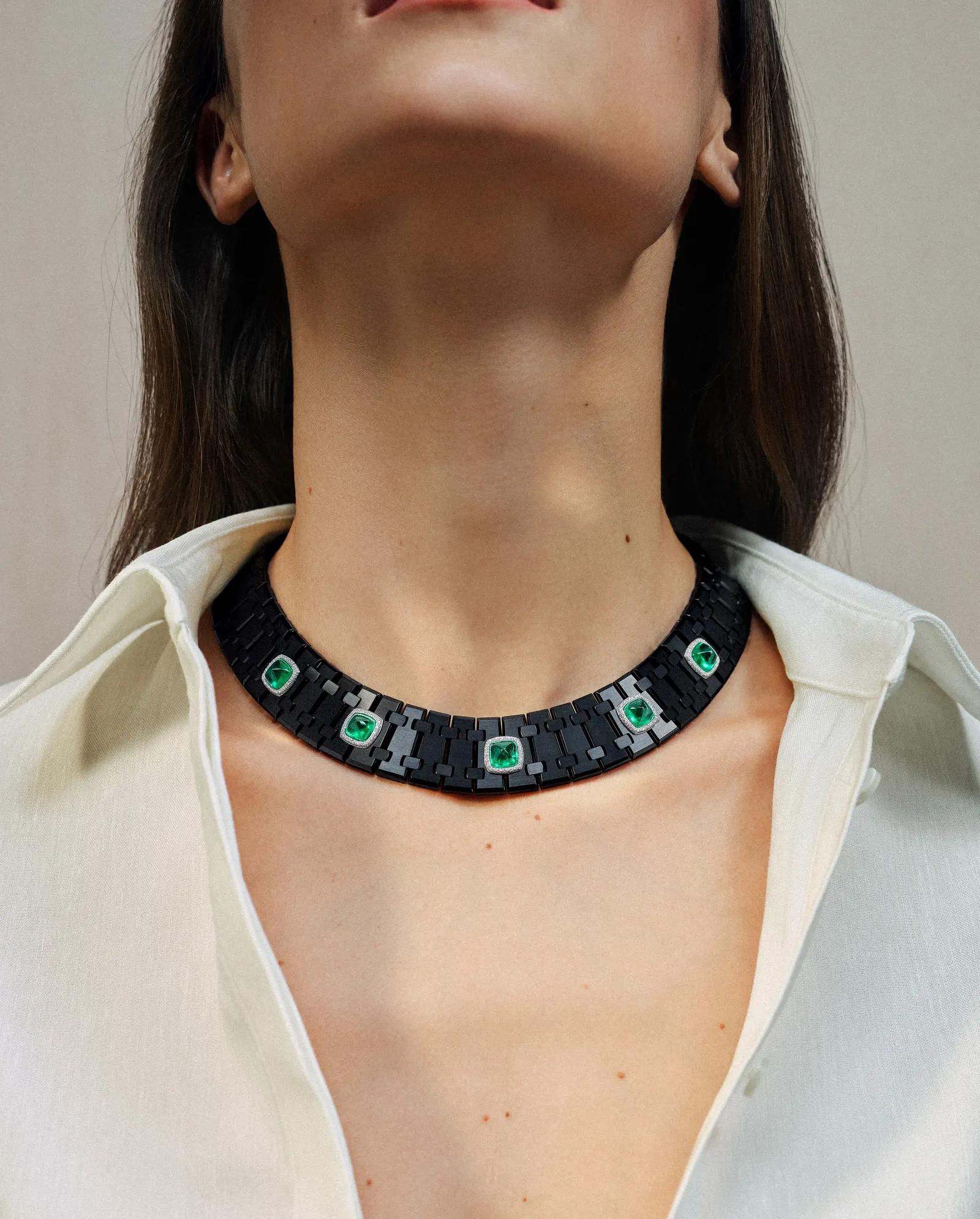
The Risoud Eclipse Royal Oak necklace in blackened titanium and 18-carat white gold, set with sugarloaf emeralds framed by brilliant-cut diamonds. | Source: Audemars Piguet
There is another distinction Audemars Piguet will need to protect. Watch brands have often treated jewellery as a coded route to the female client, preserving technical watchmaking for men while offering women smaller cases, diamonds and decorative accessories. Royal Oak Joaillerie has the potential to reject that dated division.
The Royal Oak itself has become increasingly fluid in how it is worn. Smaller references are collected by men, larger models are worn by women, and watches are stacked alongside bracelets without much interest in the gender categories printed in catalogues. Resta has said that requests for jewellery and accessories came from clients beyond women alone, even though female collectors played an important role in developing the first pieces.
That broader relevance suits the Royal Oak. Its visual language has always balanced apparently opposing qualities: industrial and precious, masculine and feminine, technical and decorative. The jewellery collection will feel most contemporary if it preserves that ambiguity rather than becoming a separate, gendered annex to the watch department.
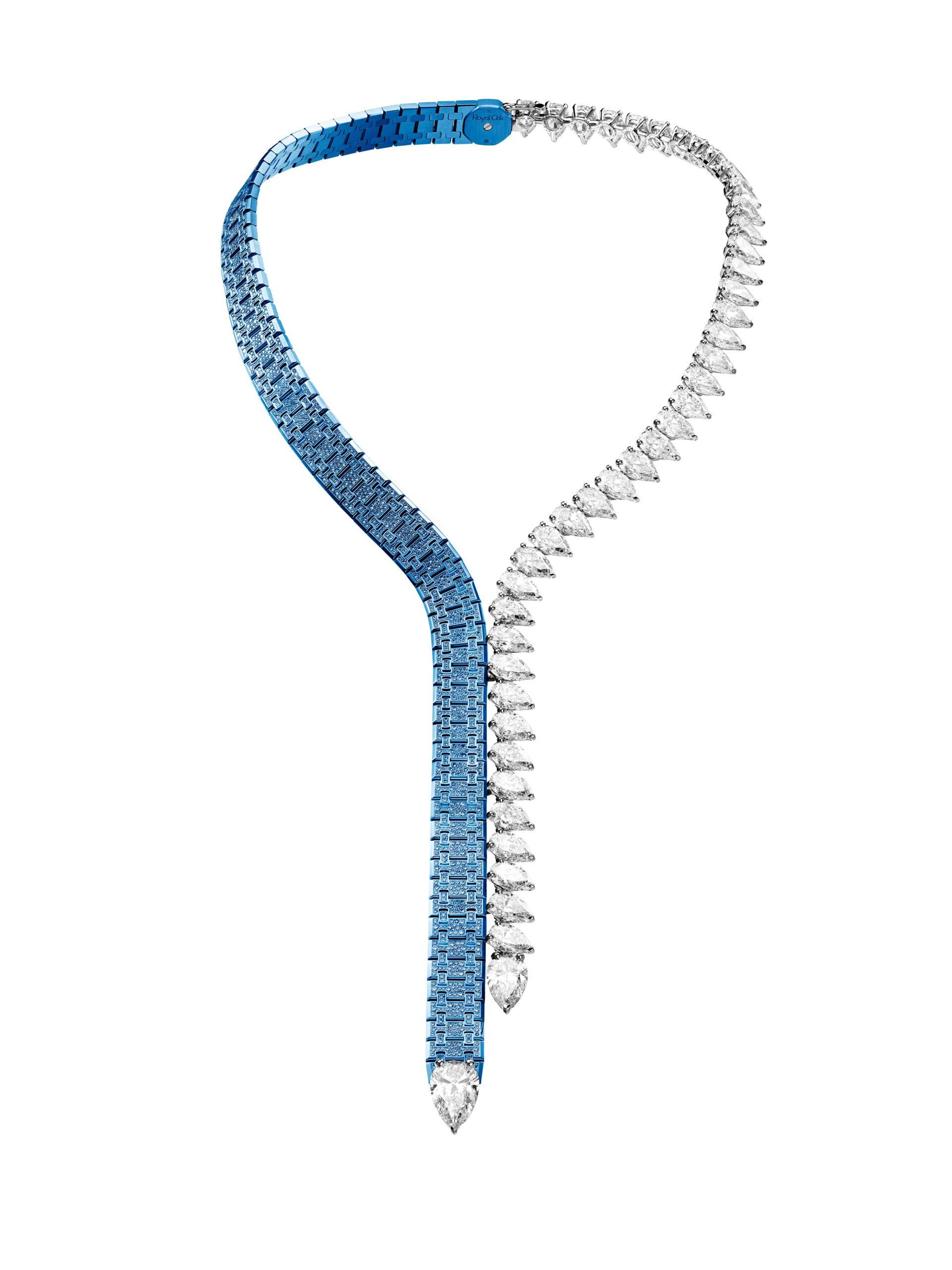
The Dream of Joux tie necklace in blue titanium and 18-carat white gold, snow-set with blue sapphires and bordered by a graduated line of pear-shaped diamonds. | Source: Audemars Piguet
High jewellery brings standards that cannot be met by brand recognition alone. A watchmaker entering the category must master not only surface finish and mechanical precision, but stone selection, setting, flexibility, balance, comfort, closures and the way a piece behaves across a moving body.
Audemars Piguet has acknowledged that it will not attempt to bring every process under one roof. The manufacture intends to work with specialist external craftspeople where their expertise is stronger, while using the project to rebuild knowledge that once existed within the company. That openness matters because jewellery is not simply watchmaking at a larger scale.
The challenge is especially visible in the Royal Oak’s articulated links. On a watch, the bracelet must hold a case securely and sit comfortably around a relatively narrow section of the wrist. A necklace or broad cuff requires a different understanding of weight, movement and anatomy. Precision is still essential, but the body rather than the movement becomes the mechanism around which the object must be designed.

Gemstones are selected and positioned by hand as the blue palette of a Dream of Joux creation begins to take shape. | Source: Audemars Piguet
The larger significance of Royal Oak Joaillerie is that Audemars Piguet now appears to view the Royal Oak as more than a watch collection. It has become a complete design system, recognisable through proportion, texture, construction and light even when its most familiar components are absent.
That approach places the Royal Oak alongside the strongest design assets in luxury. Cartier can extend the screws of Love or the geometry of Panthère across watches and jewellery because their identities are not confined to a single object. Bvlgari can move Serpenti between necklaces, watches and bags because the serpent is a language rather than a product.
Audemars Piguet must now prove that the Royal Oak possesses the same elasticity. The first jewellery collection suggests that it does, but future chapters will need to create new forms rather than simply preserve familiar ones. The most convincing legacy for Genta’s design would not be its repetition forever, but its ability to continue producing unexpected ideas.
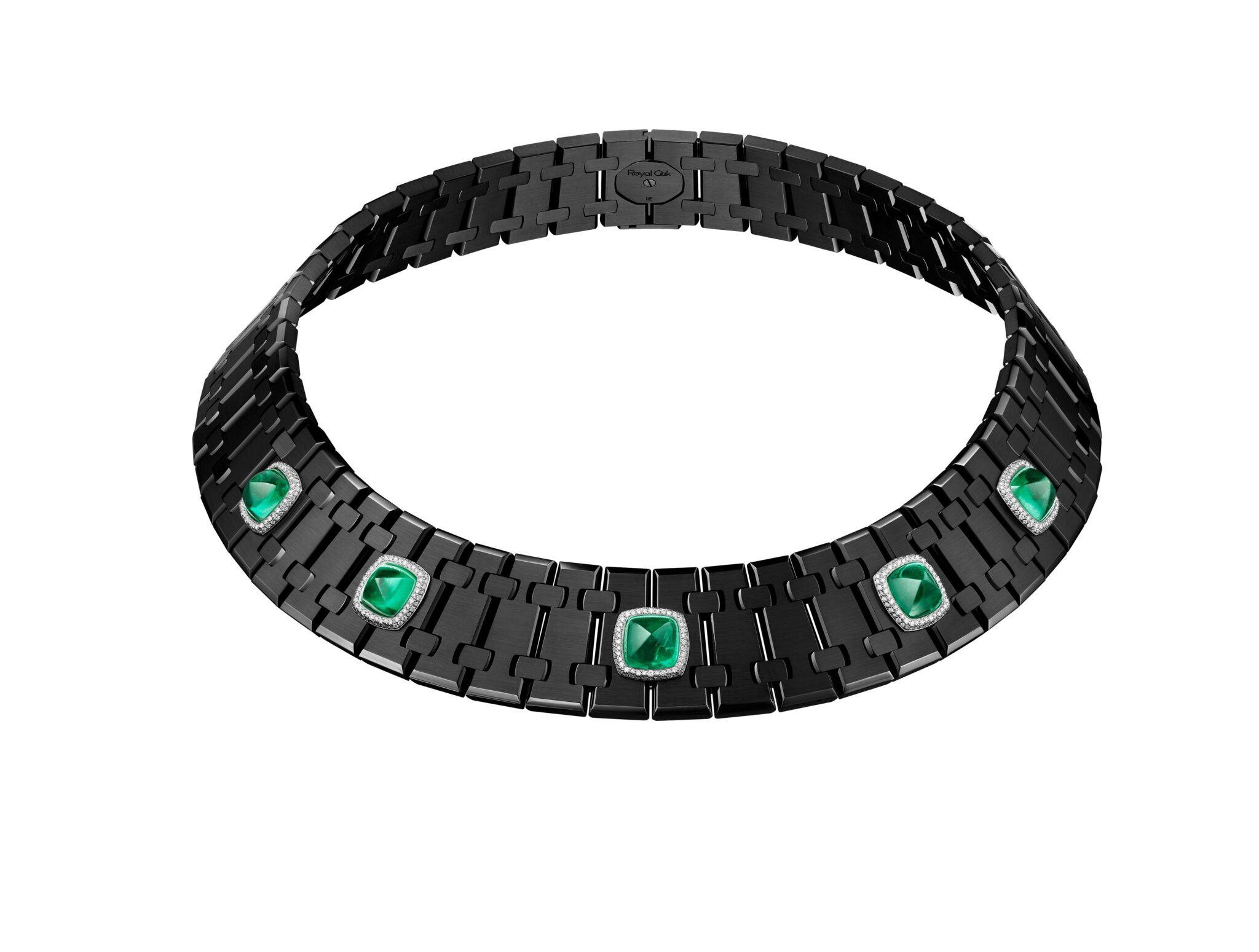
The Risoud Eclipse Royal Oak necklace in blackened titanium and 18-carat white gold, punctuated by five sugarloaf emeralds framed with brilliant-cut diamonds. | Source: Audemars Piguet
Royal Oak Joaillerie succeeds conceptually because it reveals something that was present from the beginning. The Royal Oak did not become jewellery when Audemars Piguet added diamonds, coloured stones or a necklace clasp. It became jewellery in 1972, when steel was shaped, articulated and finished with such intensity that the bracelet and case became inseparable.
The new collection simply removes the element that once provided the object with its category. Without a dial or movement, we are left with geometry, craftsmanship, texture and the intimate relationship between metal and the body. Those are not borrowed jewellery codes. They are the qualities that made the Royal Oak revolutionary in the first place.
The strategic value is equally clear. Audemars Piguet is not using jewellery merely to place its logo into another lucrative market. At its best, Royal Oak Joaillerie gives the manufacture a laboratory for stone cutting, gem setting, articulation and precious-metal work that can enrich its watchmaking in return.
The test will come after the excitement of the first collection. If Audemars Piguet continues to take risks and permits the jewellery to evolve beyond recognisable quotations, Royal Oak Joaillerie could become an important creative pillar. If it settles for reducing and repeating the bracelet, it will remain an elegant accessory to a more powerful watch.
For now, the collection makes a compelling argument. Take away the hands, dial and movement, and the Royal Oak remains unmistakably itself. Few watches could survive that subtraction.
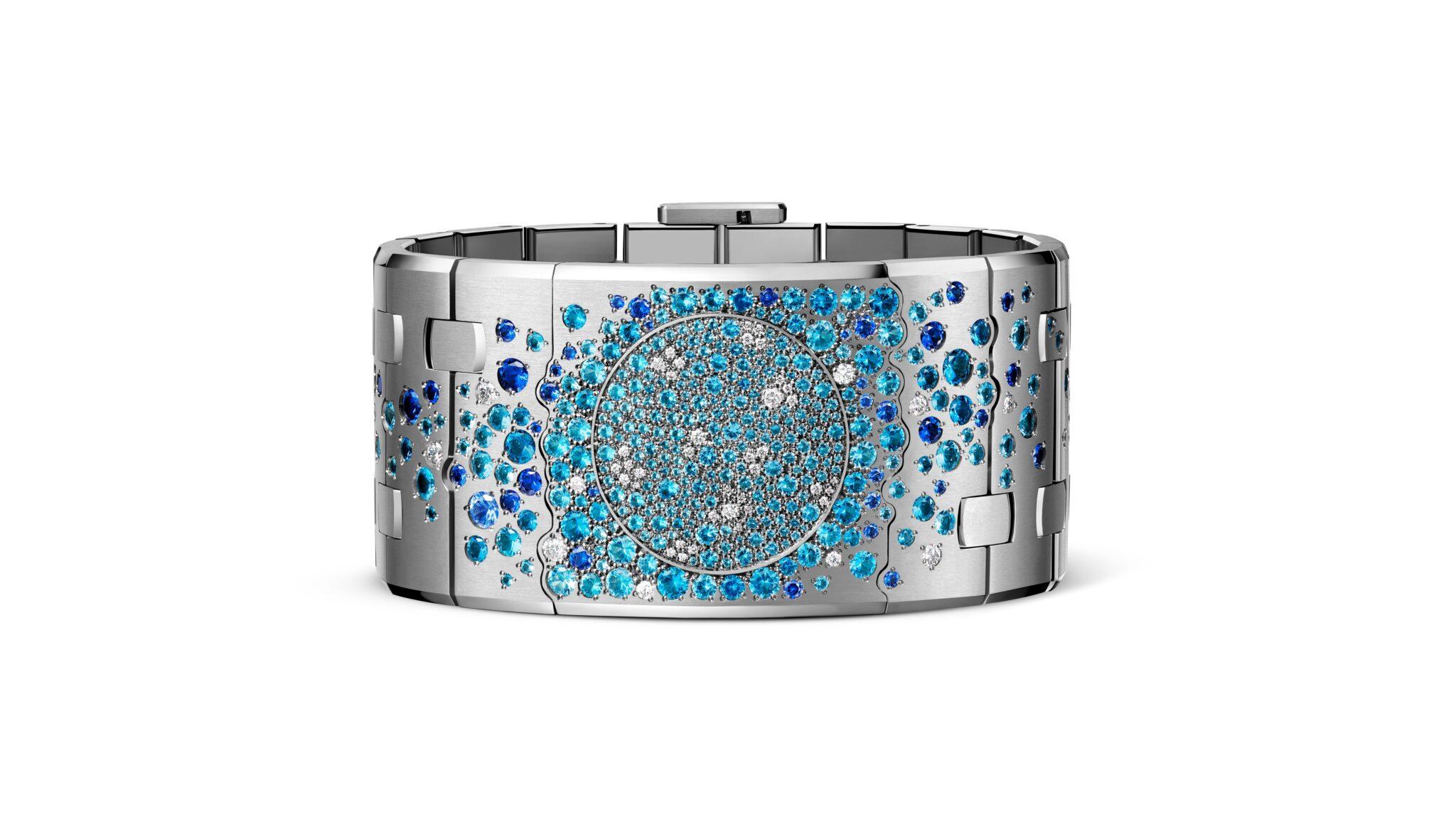
The Dream of Joux Blue Moon cuff in 18-carat white gold, set with blue sapphires, aquamarines and diamonds in a celestial composition. | Source: Audemars Piguet
Explore the new Royal Oak Joaillerie collection and discover its exceptional craftsmanship on the Audemars Piguet website.
Scroll the gallery below to see more
HIGH JEWELLERYAPR 22, 2026
Chopard Caroline’s Garden: A Personal Vision In Full Bloom
Chopard’s Caroline’s Garden transforms nature into high jewellery through bold gemstones, innovative settings and a deeply personal creative vision
READ MORE
FINE JEWELLERYAPR 23, 2026
Chopard Ice Cube ‘Be Cube’: A Shift in How the Cube Is Seen
Chopard introduces “Be Cube”, a new chapter within its Ice Cube collection, refining the motif into a more sculptural and considered form
READ MORE
HIGH JEWELLERYAPR 25, 2026
Tiffany & Co. Blue Book 2026: Hidden Garden
Tiffany’s Blue Book 2026 collection, Hidden Garden, explores nature through movement and construction, with a more controlled approach to high jewellery
READ MORE



0 Comments
You must be logged in to comment. Click here to login.